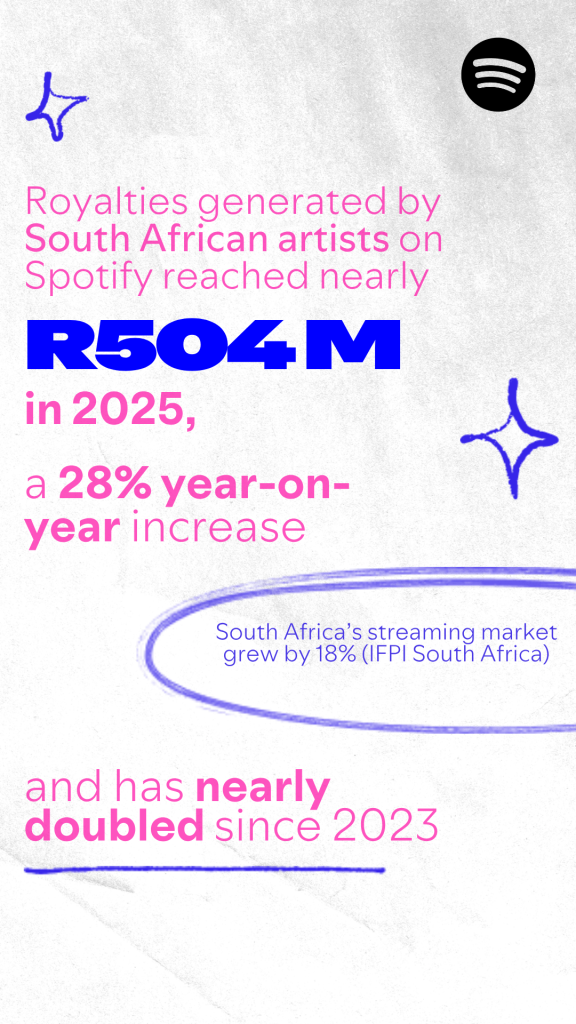
South African music is not just growing, it is scaling globally at a serious pace. New data from Spotify reveals that local artists generated over R504 million in royalties in 2025, marking a 28% increase year-on-year and nearly doubling earnings since 2023.
Local Talent, Global Demand
The numbers tell a clear story. South African artists are no longer just dominating locally, they are reaching audiences across the world.
Nearly 74% of all royalties earned by local artists on Spotify in 2025 came from listeners outside South Africa, showing just how far the sound is travelling. At the same time, discovery is accelerating. South African artists were found by first-time listeners over 1.6 billion times, a 40% jump from 2024.
The Rise of Independent Artists
One of the most significant shifts is who is earning. More than half of all royalties generated came from independent artists and labels, signalling a major change in how music success is being built. This reflects a broader industry move where artists are leveraging digital platforms to grow audiences without relying entirely on traditional systems.
The Sound of South Africa Is Evolving
While Amapiano continues to define the country’s global identity, new genres are quietly gaining momentum. Spotify data shows strong growth in cloud rap, pop country, acoustic country, pop rap and worship, highlighting how diverse South African listening habits have become.
Language is also playing a key role. Music performed in Zulu saw a 37% increase in global royalties year-on-year, and more than 120% growth over two years, reinforcing the global appetite for authentic, local storytelling.
Women in Music Are Gaining Ground
Female artists are seeing steady growth both locally and internationally. Local streams of South African female artists increased by 22%, while international streams rose by 20%, pointing to a more balanced and expanding industry landscape.
More Than Just Streaming Numbers
The data comes from Spotify’s Loud & Clear report, an initiative launched to bring transparency to how artists earn from streaming. According to Joceleyne Muhutu-Remy, Managing Director of Spotify Sub-Saharan Africa, the numbers reflect more than just growth.
They confirm that South African artists have become a globally dominant creative force, driven by demand that stretches far beyond the continent.
A Growing Responsibility
With that growth comes pressure. In a statement, Minister of Communications and Digital Technologies Solly Malatsi called on Spotify to continue investing in African languages, skills development and transparency within the music ecosystem.
Spotify acknowledged the challenge, reinforcing its role in supporting and amplifying African voices on a global scale.